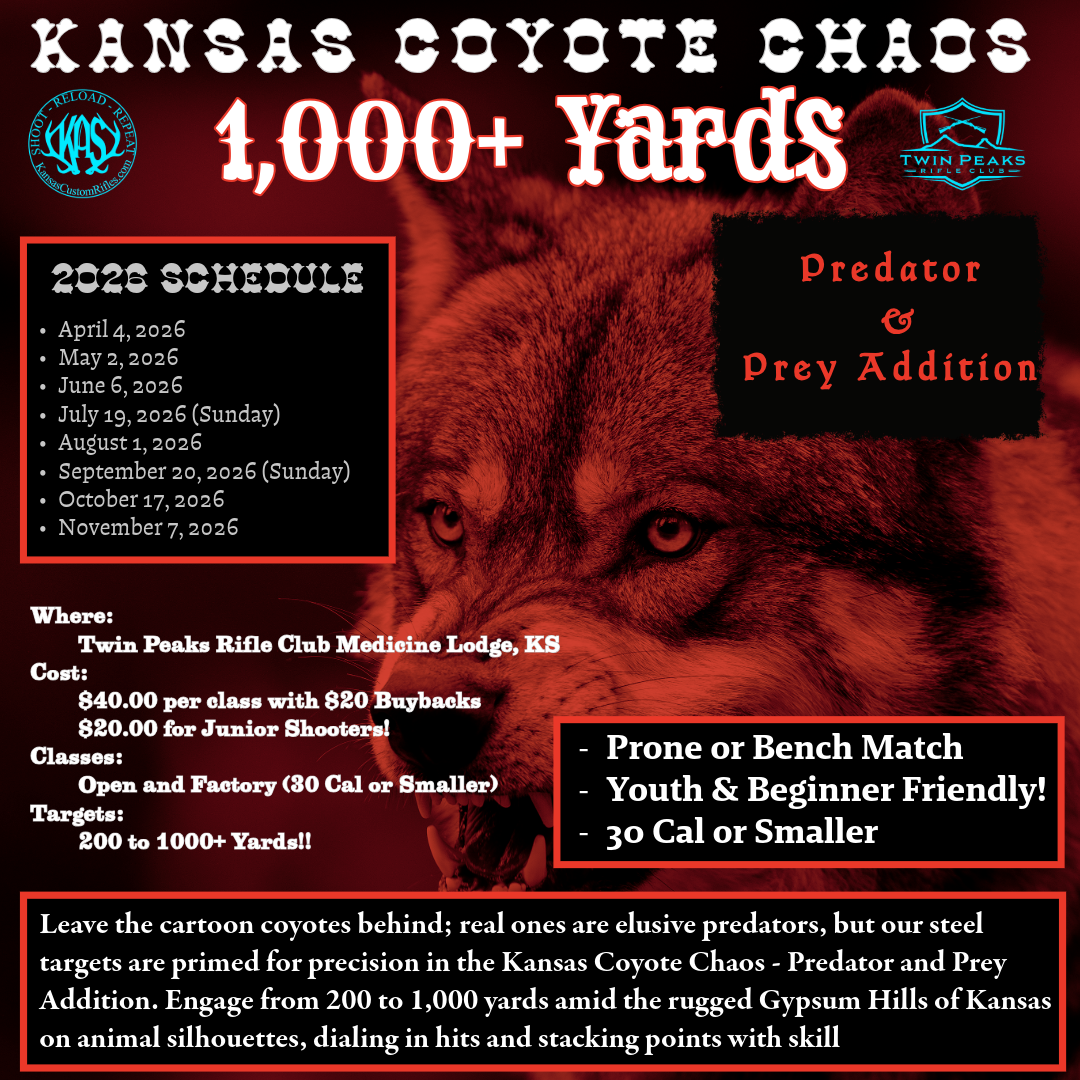
In the vast, wind-swept plains of Kansas, where the horizon stretches endlessly and the elements test every ounce of a shooter’s skill, lies an event that’s capturing the hearts of precision rifle enthusiasts: the Kansas Coyote Chaos. This long-range steel target shooting match isn’t just a competition—it’s a thrilling blend of marksmanship, strategy, and camaraderie, designed to push participants to their limits while keeping things accessible and fun. Hosted by the Twin Peaks Rifle Club in Medicine Lodge, Kansas, and organized by Kansas Arms Supply, the match invites shooters to engage coyote-shaped steel silhouettes from distances starting at 200 yards and extending beyond 1,000 yards—sometimes even reaching 1,400+ yards. Whether you’re a seasoned pro with a custom rig or a beginner wielding a stock factory rifle, this event emphasizes precision, wind reading, and time management in a relaxed, safety-first environment.
What sets Kansas Coyote Chaos apart from more intense competitions like the Precision Rifle Series (PRS) is its beginner-friendly vibe. There’s no need for high-stakes pressure; instead, the focus is on enjoyment, learning, and connecting with fellow shooters. With options for prone or bench shooting, limited shots per stage, and even a “buy-back” feature to stay in the game after a miss, it’s an ideal gateway into long-range shooting. Let’s dive deep into what makes this match tick, from its structure and rules to the classes, safety protocols, and tips for success.
The Essence of the Match: Overview and Appeal
At its core, Kansas Coyote Chaos is a test of accuracy and consistency against unforgiving steel targets that mimic the elusive coyote. Shooters progress through escalating distances, one stage at a time, with each successful hit advancing them further. The event is divided into relays, where groups of 5 to 10 competitors tackle multiple distances in sequence. For a standard 1,000-yard match, this might mean shooting 200, 300, and 400 yards in the first relay, then 500, 600, and 700 in the second, followed by 800 and 900 in the third, and culminating in a finale at 1,000 yards. Matches extending beyond 1,000 yards add extra relays for 1,100, 1,200, 1,300, and 1,400 yards, with the final relay serving as a tiebreaker based on time.
The match’s laid-back atmosphere is a big draw. It’s not a grueling PRS-style ordeal with complex stages and heavy gear hauls; instead, it’s prone-style or bench shooting with a single target per distance. Safety, fairness, and fun are the guiding principles, making it perfect for all ages and skill levels—from complete novices dipping their toes into precision shooting to experienced marksmen honing their craft. If the notorious Kansas winds throw you off, a $20 buy-back lets you re-enter at the next distance, keeping the frustration low and the excitement high.
Prizes add to the allure: Trophies go to the top two finishers in each class, and participants earn dog tags commemorating their farthest distances. The maximum round count is kept reasonable—about 50 for 1,000-yard matches and up to 95 for longer ones—but savvy shooters bring extras for buy-backs or practice.
Competing Classes: Open vs. Factory
Shooters compete in one of two distinct classes, each with its own leaderboard to ensure fair play. The classes are tailored to accommodate different equipment levels, allowing custom builds to shine without overshadowing stock rifles.
- Open Class: This is the anything-goes category for those with specialized setups. It includes all PRS, benchrest, F-Class, and modified factory rifles. Key restrictions: Calibers must be .30 or smaller, with no steel-core or penetrator ammo (to protect the AR500 steel targets). Rifles weighing over 14 pounds (including scope and bipod) automatically fall here, as do any that don’t meet Factory Class criteria. It’s ideal for custom or heavier rifles where modifications enhance performance.
- Factory Class: Designed for off-the-shelf rifles, this class promotes accessibility by limiting modifications. Rifles must be from approved manufacturers (produced in quantities over 3,000 units per year) and weigh under 14 pounds (including scope, bipod, and accessories like data cards or rangefinders—suppressors and slings are excluded to encourage suppressor use). No custom barrels, heavy mods, or alterations to the action, bolt, stock, trigger, or barrel contour are allowed. You can add rails or cheek risers via factory mounting points, use detachable magazines if they fit, and thread the barrel for a muzzle device or suppressor. Triggers must stay in factory condition, though adjustable ones can be tuned per manufacturer specs.
Approved manufacturers for Factory Class include a wide range: Barrett, Bergara, Beretta, Browning, Christensen Arms, Colt, CVA, CZ, Daniel Defense, Fierce, FN, Henry, Howa, Kimber, Marlin, Mauser, Mossberg, Remington, Ruger, Sako, Savage, Seekins, Sig Sauer, Smith & Wesson, Springfield, Stag Arms, Steyr, Thompson, Tikka, Victrix, Weatherby, and Winchester. Any factory model variant (SKU) from these brands qualifies, as long as it adheres to the rules.
Both classes enforce the same caliber and ammo limits, with verification at registration via weight checks and chronographs for muzzle velocity.
Safety First: Rules and Disqualifications
Safety is non-negotiable in Kansas Coyote Chaos, with strict protocols to protect everyone on the range. All participants must follow range rules, wear mandatory ear protection, and use chamber flags. Bolts must be open and to the rear at all times when not actively shooting. No steel-core ammo (like M855 or M80) is permitted, and coaching or spotters are banned while a shooter is on the clock—it’s all about individual skill.
Disqualifications are swift for violations, including unsafe or disrespectful behavior, prohibited equipment, flagging others with a rifle (loaded or not), firing before cleared, or failing to safe the rifle (bolt back, flag inserted) before leaving the line. The emphasis is on a positive, respectful environment where everyone can enjoy the sport.
Targets, Shooting Rules, and Scoring
The setup is simple yet challenging: One steel coyote silhouette per distance, engaged from prone or a bench. Distances start at 200 yards and increase progressively, with RO (Range Officer) spotters using optics and target flashers for hit confirmation beyond 900 yards.
- Shots Allowed: Varies by distance—4 shots max for 200-500 yards, 5 for 600-800, 8 for 900-1,100, and 10 for 1,200+.
- Time Limits: 60 seconds for 200-500 yards, 90 for 600-800, and 120 for 900+.
- Scoring: Only the first hit counts, with points decreasing per shot used. For example, at 200-500 yards: 4 points for first-shot hit, down to 1 on the fourth. At 900-1,100: 8 points for first, down to 1 on the eighth. At 1,200+: 10 for first, down to 1 on the tenth. This rewards clean, first-round impacts while allowing recovery from misses.
- Advancement: A hit advances you; miss all shots or run out of time, and you’re out—unless you opt for the $20 buy-back. The finale relay’s time serves as a tiebreaker.
Time starts on a beep or command, and ROs enforce limits strictly. Pauses between distances allow for buy-backs, keeping the flow smooth.
Who Should Join, Where, and How Much?
This match is tailor-made for anyone curious about long-range shooting. It’s beginner-friendly, welcoming all levels, and fosters a community vibe where you can test skills, meet peers, and enjoy the outdoors. No prior competition experience needed—just bring your rifle, ammo, and a positive attitude.
- Location: Twin Peaks Rifle Club, Medicine Lodge, KS.
- Cost: $40 per shooter per class; $20 for youth. Entries are non-refundable.
Whether you’re frustrated by real coyotes evading you in the field or simply seeking an addictive challenge against steel “beasts,” Kansas Coyote Chaos delivers. It’s more than a match—it’s a celebration of precision shooting in one of America’s most iconic landscapes. Grab your gear, dial in your dope, and prepare to conquer the chaos. For more details or to register, check with Kansas Arms Supply or the Twin Peaks Rifle Club. See you on the range!
 Kansas Coyote Chaos
Leave a comment